


A British Overseas Territory southeast of the Bahamas, the Turks and Caicos archipelago has been settled, charted, and quietly held for centuries. English is the official language, the US dollar is the official currency, and most travellers come for the same reason islanders stay: forty cays of soft white sand, calm protected water, and sunshine that runs nearly year-round.
Turks and Caicos • British West Indies
The Turks and Caicos Islands.
Forty low cays in the northern Caribbean. The world’s third-longest barrier reef along the front porch.
The Geography
Two island groups, one archipelago.
Forty cays divided into two groups: the Caicos Islands to the west, the Turks Islands to the east.
The Caicos Islands hold most of the population and most of the tourism. Providenciales — locally called Provo — is the main hub, with the international airport, the resort row, and Grace Bay Beach. North Caicos, Middle Caicos, and South Caicos sit quieter, with limestone caves, traditional fishing villages, and more uninhabited shore than developed.
The Turks Islands sit to the east, separated from the Caicos by a thirty-mile-wide channel that humpback whales pass through every winter. Grand Turk holds the colonial capital. Salt Cay, just south, has fewer than a hundred residents and a salt-pond history dating back four centuries.
The whole archipelago is rimmed by the world’s third-longest barrier reef. Inside the reef, the water is shallow, calm, and warm. Outside, the wall drops thousands of feet into the deep blue of the Atlantic.
On the map
Where is Turks and Caicos?
Where the Bahamas ends, and the Caribbean begins.
Turks and Caicos sits at the southeastern edge of the Bahamas archipelago. Culturally Caribbean; geographically Atlantic — the islands are washed by the North Atlantic Ocean, not the Caribbean Sea. About 575 miles southeast of Miami — a 1 hour 30 minute direct flight — and 100 miles north of the Dominican Republic. Politically the islands are separate from the Bahamas: a British Overseas Territory in their own right.
The two island groups — the Caicos Islands to the west and the Turks Islands to the east — are separated by the Turks Island Passage, a 22-mile-wide, 7,000-foot-deep channel that hosts one of the world’s most reliable humpback whale migrations each January to April.
21°42′ N · 71°48′ W
The Islands
Each island, a different rhythm.
Eight inhabited islands in the archipelago. Each one a different speed.
Providenciales (Provo).
The ‘big city’. Our most populated and developed island, and home to Grace Bay Beach. The international airport, the resort row, the best restaurants, and most of the villa rental market. Where most visitors stay.
North Caicos.
The greenest of the islands. Reached by ferry from Providenciales. Limestone caves at Cottage Pond, miles of empty beach at Sandy Point, the only freshwater wetland in the archipelago. Settled in the late 1700s. The ruins of Wades Green Plantation, the best-preserved 18th-century site of its kind in the Caribbean, still stand inland from Kew.
Middle Caicos.
Connected to North Caicos by causeway. Mudjin Harbour and Crossing Place Trail run along the dramatic limestone cliffs. The Conch Bar Caves are the largest cave system in the Caribbean and were used by Lucayan Indians, the earliest known inhabitants of the islands. The cave system has pre-Columbian rock carvings.
South Caicos.
The fishing capital of the islands, reached by direct flight from Miami. The Boiling Hole pulses with the tide. Salt pans and a nineteenth-century church frame Cockburn Harbour. Quiet, working, and increasingly attracting boutique resort development.
Grand Turk.
The country’s capital. Cockburn Town, among the oldest continuously inhabited settlements in the archipelago. Eight square miles, narrow streets of pastel houses, Bermudian-style architecture. The cast-iron lighthouse, shipped from England in 1852, still stands. Cruise ships dock on the western side. One of the best wall dives in the Caribbean a short boat ride offshore.
Salt Cay.
Fewer than a hundred residents. The salt-pond system dates to the 1640s; some of the original stone walls still stand. Donkeys grazing on the road. January through April, humpback whales calving offshore. The slowest pace in the country, by a wide margin.
West Caicos.
Uninhabited and undeveloped. The wall drops thousands of feet a short swim from shore: Elephant Ear Canyon, Magic Mushroom, the Anchor. Some of the best wall diving in the Caribbean. Lake Catherine sits inland, a salt pond where flamingos winter. The ruins of Yankee Town, an 1880s sisal plantation with a Burrell steam engine still in place, mark a brief industrial boom that left as quietly as it arrived. Reached by charter boat from Providenciales.
Getting Here
Direct Flights from most major US cities.
Providenciales’ International Airport (PLS) is the country’s main hub.
Direct flights from New York, Boston, Charlotte, Atlanta, Miami, Dallas, Chicago, Toronto, and London. Most flights land in the afternoon and depart in the morning. PLS handles immigration, customs, and ground transport in a single small terminal — friendly, calm, and quick.
VIP Fast Track service moves you through immigration and security ahead of the queue, and is worth arranging for peak holiday weeks. We can have it set up before you arrive.
South Caicos Airport (XSC) now receives a few direct flights from Miami, offering a quieter, faster route to the eastern end of the archipelago.
Getting Around
Rent a car. Hop in a taxi.
A small place, easily navigated.
On Providenciales, most guests rent a car for the week. Driving is on the left (UK style), but the roads are short. Most car rentals deliver to the villa. Taxis from the airport are reliable, but priced per person and by destination, not by meter. Worth knowing before you get in. Private SUVs and Sprinter vans can be arranged for groups.
On the smaller islands — Grand Turk, South Caicos, Salt Cay — bicycles, golf carts, and walking are the main forms of transport. The slower pace is part of the appeal.
When to Visit
No month is wrong, only different.
A year-round destination, with each season offering something distinct.
December through April.
High season. Drier, sunnier, eighty-degree days, low humidity. Resort row is full, calendar fills first. Book six to twelve months ahead for the holiday weeks.
May through August.
The quieter middle months. Warmer water, longer days, briefer crowds. Afternoon showers in June and July refresh and then pass. Rates ease, restaurants stay open, the water at its most luminous.
September through November.
Hurricane peak runs August through October, September the most active. Major storms are uncommon but they happen; we plan around it. November is one of the best months — quiet, warm, calmest water.
Things to Do
From the reef to the road.
Eight inhabited islands in the archipelago. Each one a different speed.
On the water.
Snorkelling the third-longest reef in the world. Diving the wall sites off West Caicos and Northwest Point. Catamaran cruises to the uninhabited cays. Fishing on the flats (bonefish), the reef (snapper, grouper), and offshore (big game). Kiteboarding at Long Bay, paddleboarding at Sapodilla Bay.
Down the Road.
Horseback rides on Long Bay Beach at low tide. ATV tours through the back roads. Golf at Royal Turks and Caicos Golf Club. Junkanoo at the Thursday Fish Fry in The Bight.
Day trips to the outer islands.
The ferry to North and Middle Caicos for the day. Snacks at Bambarra Beach. Limestone caves at Conch Bar. The cliffs at Mudjin Harbour. Late lunch at Baracuda Bar.
Where to Stay
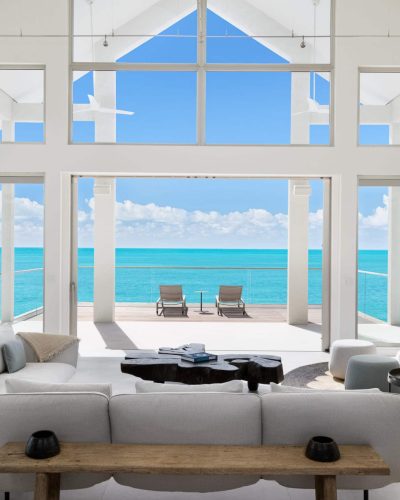
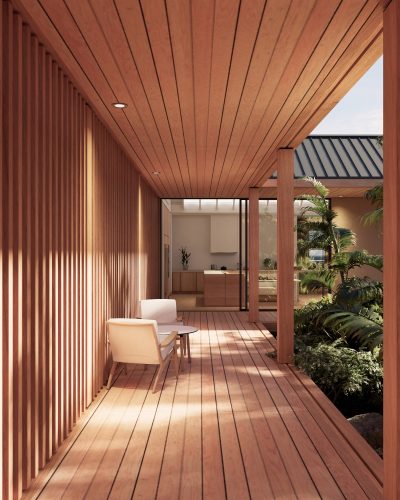
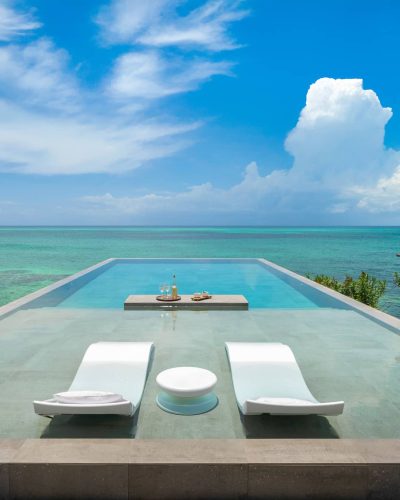
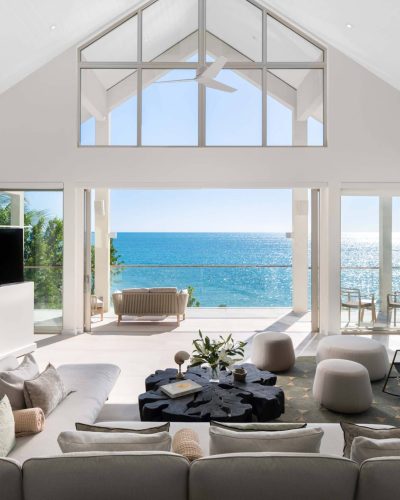
Villa rentals on Providenciales.
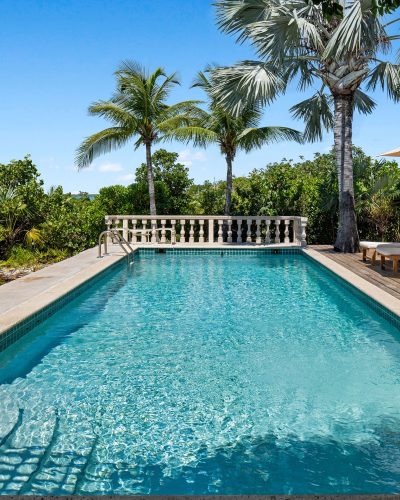
A handpicked collection of six properties across the quieter shores of the island.
Questions
Your questions answered.
Where is Turks and Caicos?
Turks and Caicos sits at the southeastern edge of the Bahamas archipelago. Culturally Caribbean; geographically Atlantic — the islands are washed by the North Atlantic Ocean, not the Caribbean Sea. About 575 miles southeast of Miami — a 1 hour 30 minute direct flight — and 100 miles north of the Dominican Republic. Politically the islands are separate from the Bahamas: a British Overseas Territory in their own right. Coordinates: 21°42′ N, 71°48′ W.
Is Turks and Caicos in the Caribbean or the Atlantic?
Both, depending on how you count. Culturally Turks and Caicos is Caribbean. Geographically the islands sit in the North Atlantic Ocean, not the Caribbean Sea itself — the Caribbean Sea proper begins south of the Dominican Republic. Most travel sites get this wrong.
How far is Turks and Caicos from Miami?
About 575 miles southeast of Miami — a 1 hour 30 minute direct flight. Direct flights also run from New York, Boston, Atlanta, Toronto, and London.
What country does Turks and Caicos belong to?
Turks and Caicos is a British Overseas Territory. The islands are self-governing under a UK-appointed governor, with their own laws, courts, and immigration. The British monarch is head of state.
What language do they speak in Turks and Caicos?
English is the official language and is spoken universally across the islands.
What currency is used in Turks and Caicos?
The US Dollar. There is no local currency — prices, ATMs, restaurants, and shops all quote and accept USD directly.
Do I need a passport to travel to Turks and Caicos?
Yes. A valid passport is required for all visitors. Most nationalities — including the US, Canada, UK, and EU — do not need a visa for stays under 90 days.
When is the best time to visit Turks and Caicos?
Turks and Caicos enjoys warm, dry weather year-round. The most popular season runs November through April with cooler nights and low rainfall. May through October brings warmer water and quieter beaches, with occasional short showers. The islands sit south of the main Atlantic hurricane track.
What are the two island groups in Turks and Caicos?
The Caicos Islands to the west and the Turks Islands to the east, separated by the Turks Island Passage — a 22-mile-wide, 7,000-foot-deep channel that hosts one of the world's most reliable humpback whale migrations each January to April.
Plan Your Stay
Tell us about your visit.
We’ll help you choose the island, the shore, the villa.
Tell us when you’re thinking of visiting, how many will be in the party, and what you’d like the days to feel like. We’ll respond personally with the villa, the shore, and the local plan that suits you best.

A handpicked collection of luxury villa rentals in the Turks and Caicos Islands.
Contact usCorrespond
An occasional letter. Never more than monthly.