


Featured
Jojo the Dolphin, Turks and Caicos’ wild celebrity.
The story of Turks and Caicos’ most famous resident — a wild bottlenose dolphin who has chosen the company of humans for over forty years.
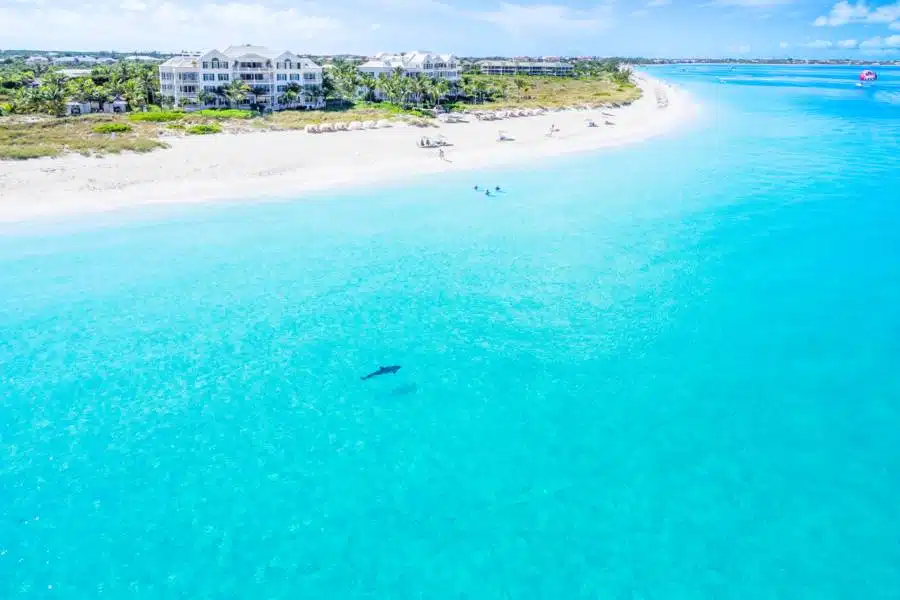
JoJo is a ten-foot male Atlantic Bottlenose dolphin who has spent most of his life swimming the waters between Grace Bay, the cays, and the Caicos Banks. He is a wild animal, but he is also unmistakably a public figure — a national treasure, formally designated. For more than four decades he has sought out humans on the water, riding boat wakes, following divers, and occasionally scratching his belly on anchor lines.
He is the reason many Turks and Caicos children grew up believing dolphins would come and find them if they got in the water. That belief was correct. He has been part of the island — and our own team’s memory of it — for as long as any of us can remember.
The short answer
Who — JoJo, a solitary wild bottlenose dolphin who has lived along the Provo coast since the 1970s.
Where — the north shore, most often between Grace Bay Beach and Fort George Cay. Sometimes as far as North Caicos.
How to see him — on a boat charter along the north shore. Sightings are common but never guaranteed.
The rule — observe. Don't touch, chase, or feed. He'll approach if he wants to.
His companion now — a younger dolphin named Dreamer, born in 2018, who has picked up JoJo's habit of coming to say hello.
Who is JoJo?
JoJo is unusual for a dolphin. Atlantic Bottlenose dolphins are social — they live and hunt in pods, sometimes numbering into the dozens. JoJo has chosen otherwise. He is what marine biologists call a solitary sociable dolphin: he lives alone, but he seeks out humans instead of other dolphins.
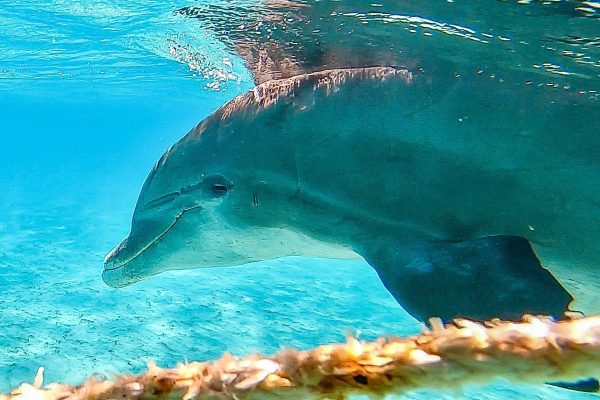
There are perhaps a dozen documented cases of solitary sociable dolphins worldwide. JoJo is the most famous. He is around ten feet long, weighs several hundred pounds, and has been photographed thousands of times — you can identify him by the propeller scars on his back and dorsal fin, gathered over decades of wake-surfing behind boats a little too closely.
His preferred waters run along the north shore of Providenciales, from Grace Bay Beach west to Fort George Cay and out to the sandbars beyond. He is, in the loosest possible sense, our neighbour.
Growing up with JoJo.
Provo is a small island. Anyone who grew up here in the 1980s and 90s — when the island had a fraction of the population and infrastructure it does today — has a JoJo story. He would routinely appear in the shallow water off Pelican Beach, off Grace Bay, off the sandbars near Leeward. Families would spot him and head straight for the water. He would swim in to investigate, circle, sometimes stay for an hour, sometimes leave in a minute.
Those early beach encounters became boat encounters over the years, first with tour operators like Sail Beluga and later with private charters working the north shore. Every captain, guide, and long-time resident on Providenciales has their own version of the same story.
This is what makes JoJo different from other wildlife encounters. He is not something you go to see. He is someone the whole island knows.

The beginning.
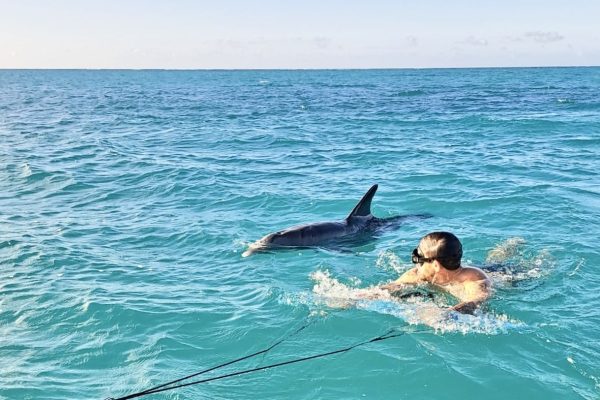
JoJo first came to public attention in the early 1980s, when American wildlife advocate Dean Bernal moved to Turks and Caicos and began long daily swims off Providenciales. JoJo, then still a young dolphin, started joining him. What began as coincidence became routine; eventually JoJo became Dean’s diving partner. Their friendship is the most-documented and longest-running — but it wasn’t the only one. Local captains, guides, boat crews, and families were building their own history with JoJo in parallel, on their own boats and off their own beaches.
Our founder Delphine was one of those local children. She first swam with JoJo in the shallows off Leeward in the late 1980s, when the island had a fraction of the population it does today — one of many families on Provo whose kids grew up in his company.
Dean’s decades of advocacy — and the collective work of many others on the island to keep JoJo wild, rather than allow him to be captured for a marine park (as was proposed more than once) — is why JoJo is a national treasure today. It’s also why Turks and Caicos has some of the strongest wild-dolphin protections in the region.
Over the years, many people have formed close relationships with JoJo — Tim Ainsley of Sail Beluga, Jay Sargent of JoJo and Jay, and dozens more captains, photographers, and locals who see him week to week. He is a genuinely social animal, and he seems to remember the people who spend the most time in his water.
How old is JoJo, really?
Based on his size and characteristics when Dean Bernal first met him in the early 1980s, JoJo is believed to have been born in the late 1960s or early 1970s. That puts him in his fifties today.
Captive dolphins have been recorded living into their sixties, but wild lifespans are less certain and generally shorter. That JoJo is still here, still healthy, still curious, is remarkable — and a real credit to the community that has kept him wild and unpressured for so long.
There are days now when he moves more slowly. There are also days when he wake-surfs like he did thirty years ago.
Friends and family.
In the 1990s JoJo had a mate, Chenoa, and two calves — JoJo Jr. and Mojo — both named by Dean Bernal. Over the years, the people who spend time on the water with him have named other dolphins he’s been spotted with: Dreamer (also known as Scooter), Bo, Snipper, Raggedy Anne.
These days, when JoJo isn’t alone, he’s most often with Dreamer — a younger dolphin, likely born in late summer 2018, who has inherited JoJo’s habit of coming to say hello. Dreamer’s mother Bo has been familiar to north-shore captains for years, and between the two of them they’ve been quietly raising the next generation of sociable dolphins in TCI waters.
And as of 2026, there’s a brand-new calf kicking around the north shore — the newest name to add to the list, and a good sign the wild dolphin population here is doing exactly what a healthy one should.
Fun fact
JoJo can often be seen rubbing his belly along the anchor line of a moored boat, circling it slowly to give himself a good scratch. Captains know: if the line is spinning, look overboard.
Rocky, Missie and Silver — the Into the Blue story.
JoJo isn’t the only wild dolphin story worth telling in Turks and Caicos. In 1991, three captive dolphins — Rocky, Missie, and Silver — were brought to the islands as part of one of the most ambitious wild-release efforts ever attempted with previously captive dolphins. The project was called Into the Blue, and Provo was the place chosen to see it through.
Rocky had been caught in the Florida Panhandle in 1971 and held at Marineland Morecambe in the north of England. Missie had been caught off Biloxi in 1969 and Silver in Taiwanese waters in 1978, both then housed at Brighton Aquarium. Between them, the three had spent more than sixty years in aquariums.
The Into the Blue consortium — the Born Free Foundation, the Bellerive Foundation, and the World Society for the Protection of Animals — brought them to the Caicos Conch Farm on Providenciales, at the time owned by Chuck Hess, founder of the local environmental group PRIDE. There, the dolphins were rehabilitated over months, taught again how to catch live fish, and slowly reintroduced to the ocean.
On 7 September 1991 they were moved to a floating sea pen off West Caicos. Three days later, on 10 September at 1:30 in the afternoon, all three were released into the wild.
Silver was spotted by the project team intermittently through the end of September. Rocky and Missie were not seen again by staff — but for years afterwards, fishermen and boat crews reported occasional sightings out on the banks. The release stands as a landmark moment in wild-dolphin advocacy, and TCI’s role in it is still remembered here with quiet pride.
Where to see him.
JoJo is a wild animal. Sightings are common but never guaranteed. Your odds go up dramatically if you spend time on the water, and specifically on the north shore of Providenciales.
The corridor. Grace Bay Beach west to Fort George Cay and out to the sandbars. Occasionally as far as North Caicos. This is his home range.
The activities that maximise your chances. Private boat charters, snorkel expeditions, kayak trips to the cays, sailing charters. Anything that puts you slowly along the north shore during daylight hours.
The captains who know him. Long-established operators like Sail Beluga, Sun Charters aboard the Atabeyra, Caicos Catalyst, and our sister company Panoply Sport Fishing & Luxury Charters all have deep histories with JoJo and know where he’s been showing up most recently. Local captains talk to each other on the radio — if JoJo is out, word travels fast.
Interact responsibly
The rules matter.
JoJo is friendly. He is also a wild, powerful, several-hundred-pound animal, and he sets the terms of the encounter.
Do not chase. If he wants to interact, he will come to you. If he swims away, let him.
Do not touch. Human oils and bacteria are not good for dolphin skin, and physical contact stresses him. Keep your hands to yourself.
Do not feed. Feeding wild dolphins changes their behaviour, can make them sick, and puts them at risk from boats.
Keep your distance. Especially if he is moving with other dolphins in a pod — they can be more protective and less playful than JoJo alone.
Watch the props. JoJo's propeller scars are not from swimmers. They're from boats. If you're a boat captain and he's near you, slow down or shift to neutral.
He has kept us company for forty years by choice. The best thing any of us can do is let him keep choosing.